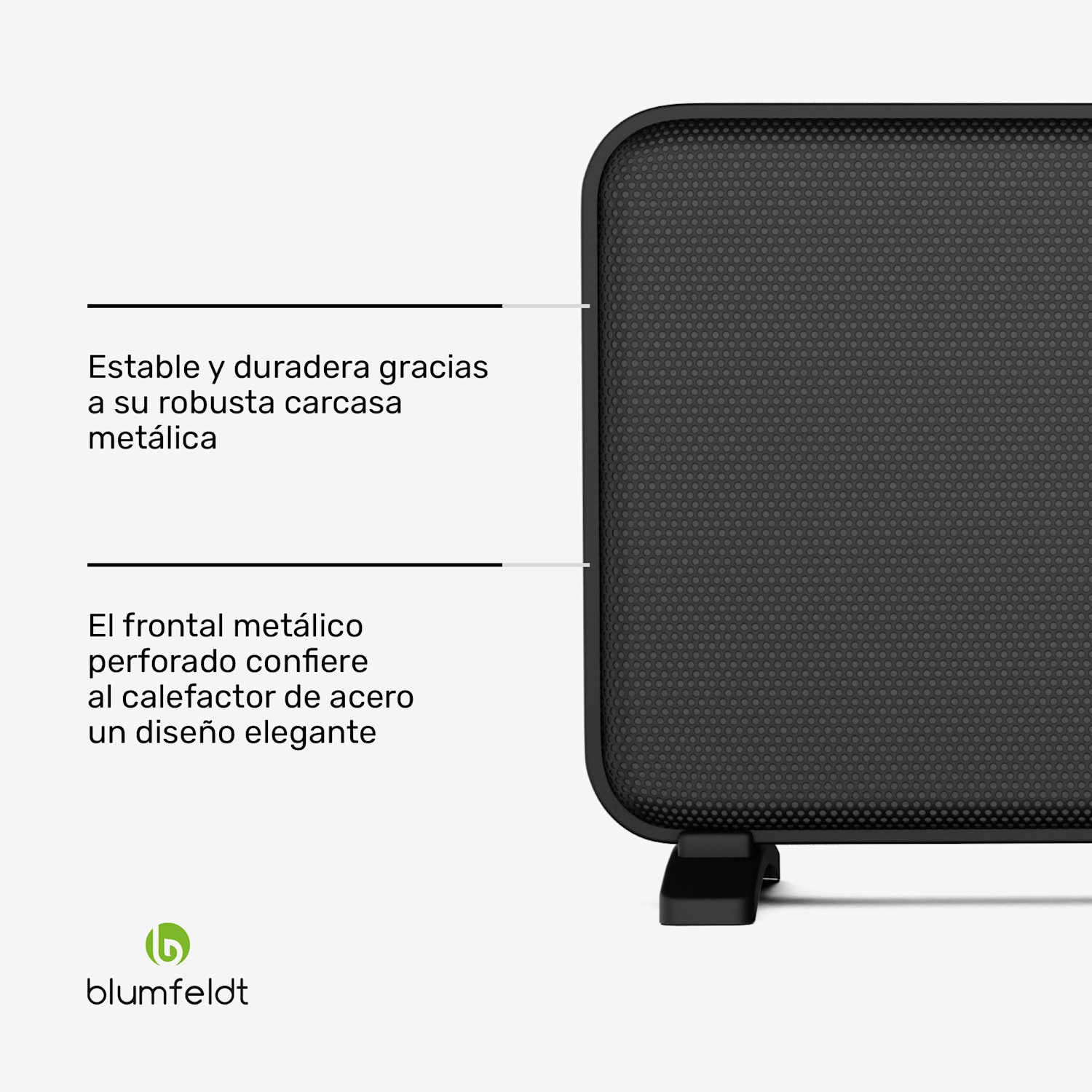
I bought this heater in combination with a 2000W mica heater for comparison after my house main heating system died and has to be repaired (try to find a tech guy that touches old gas heaters...).First off, it is not all far infrared. This heater has quite some convection heating going on too. Which is good.Sitting in the "light" side, meaning, in front of the heating panel lets you feel the radiation heat being absorbed by your skin. But on the "shadow" side, meaning on the backside or anything left or right or on top of it, as well as on the backside, things very much stay cold. My room thermometers stay 4 to 7 degrees C lower than the heaters thermostat, because they are on the "shadow" side of the heater. And the convection is maybe 20% max. on this type of heater.This heater is one-directional. The backside stays relatively cool and is fully covered.It has holes on its backside for wall- or if you are dangerously brave, ceiling mounting. Some spacers for that are included. Screws or other installation material are NOT. Considering the low range of the heating, it is most likely many buyers will use it standing nearby anyway - not on a wall far away not giving any radiation heat any more.On first use, open the windows for at least 10 minutes. It has a sweet chemical smell that fades slowly after 30 minutes of maximum power usage. After 10 minutes it is low enough to be safe, I think.The best part of this heater is that it is really and completely noiseless. No mains power frequency hum, nothing.And it seems quite safe. The top side is getting hot enough than you can burn yourself by touch. But 1cm away from the case the temperatures are safely low.Apropos case. It is a very stable steel frame (mine came with some plastic or steel parts rattling around on the inside), with a hexagonal front mesh out of steel with the flimsiest standing feet you can get. Which also have no rolls, in comparison to the advertising pictures. But since this heater is not very heavy, you can live with the cheap plastic feet. Unless you have children or pets which might fall or lean against the heater itself or kick it over.The thermostat is controlled by two infrared sensors on top of the heating element inside the case. Aprox. on the 1/4th and 3/4th position of the width. And since convection heat is just a small portion of this heating system, you get cold instantly when the thermostats turn off because they "sense" 24 degrees C when the rest of the room has only 16 degrees C. A sad disadvantage of this heating type. And bad placement of the temperature sensors, considering the take up the temperature of the IR reflection and the convection from the front grid itself (which explains the inaccuracy).And everything is depending on these not very accurate working sensors / thermostat, because you cannot control the heater otherwise. Turning the power off means for the heater, that if you turn the power on again, it stays off until you press some touch sensitive (resistive) buttons on the right side of the case to turn it on. So you will not be able to control the heater by a smart plug connected to a smart thermometer in the room.So compared to the mica heater I also bought, you either set the thermostat to 30°C and hope for the best or freeze.And the heat instantly goes away, when it turns off. The convection heat is just a too small portion to keep up. Objects radiated by the far Infrared cool off immediately. And that is why it feels weak. (Like you are OK when standing in the sunlight on a cold temperature and windy day and then a cloud shadows the sun.)So on the plus side, absolutely silent. Does what it should do - if you are sitting in front of it and over-set the thermostat. Even tho the infrared range is very, very limited and does not heat up objects apart from yourself, or rather your skin, very well.On the negative side, the convection heat part is very small. And, I know, this is the principle of this heating type. But that also means you instantly get cold when the thermostat of the heater turns it off.Also, absolutely make sure you understand that this heater is only efficient in a sense of conversion of electricity to heat (when it is turned on). It is not really efficient, just because it has a conversion rate near to 1 (no infrared or resistance type heater is). That objects, that get radiated by the far infrared, do not really turn that radiation into heat is very dependent on the (colour, porosity, structure, density, conduction, size...) surface that the heater is "shining" on. That is probably the reason they choose a black steel mesh with enough "blocking" surface to turn some portion of the IR into conversion heat. And I probably do not want to re-decorate my room just to find surfaces that conduct the radiation to heat just to be warm. The most human reaction I would see is for buyers of this heater to turn it to at least 30°C on its thermostat while sitting in a 16°C room and 6 months or a year later heads explode because of the electrical bill. So be careful or rather mindful - or at least buy a power plug consumption meter for 5 to 10 bucks with it, so you can easily see what you or rather the heater is doing for (and against) you and your electrical costs.No pictures needed on this review, but imagine the advertised pictures without the rolls on the feet. You get no rolls.Keep the manual, do not trash it. While the main functions are quite self explanatory, others are not, like the sensing of an open window and how you have to reset that off-state by hand every time (more annoying than useful in my opinion).Also, please make sure you understand that running this heater for an hour on full power means that you have to pay 2KWh to your power supplier for that hour. If you want to use this for a longer time or frequently, make sure to raise your monthly electrical fees to meet the usage.For me in that emergency use case that would mean a whopping a hundred forty five Euros (at 25 cents per KWh) electrical costs per month just to heat one 20m² room. Ouch!Right now, with a heat pump plus installation cost more than 25k, it seems the motto is, repair old now, buy new when it is cheaper. Just a shame you have to kill your CO2-bill and the next or 2nd next gens life expectancy with that. Great choices!
Compré este calefactor junto con un calefactor de mica de 2000 W para comparar después de que la calefacción principal de mi casa se estropeara y tuviera que repararse (busquen un técnico especializado en calefactores de gas antiguos...). En primer lugar, no todo es infrarrojo lejano. Este calefactor también tiene bastante calor por convección, lo cual es bueno. Sentarse en el lado "iluminado", es decir, frente al panel calefactor, permite sentir el calor de la radiación que absorbe la piel. Pero en el lado "sombra", es decir, en la parte trasera o en cualquier punto a la izquierda, derecha o encima, así como en la parte trasera, se mantiene bastante frío. Los termómetros de mi habitación se mantienen entre 4 y 7 grados centígrados más bajos que el termostato del calefactor, porque están en el lado "sombra". Y la convección es de un máximo del 20 % en este tipo de calefactor. Este calefactor es unidireccional. La parte trasera se mantiene relativamente fría y está completamente cubierta. Tiene orificios para montaje en la pared o, si se es más valiente, en el techo. Se incluyen espaciadores para ello. No se permiten tornillos ni ningún otro material de instalación. Considerando el bajo alcance del calefactor, es muy probable que muchos compradores lo usen de pie cerca, no en una pared que deje de emitir calor por radiación. La primera vez que lo use, abra las ventanas durante al menos 10 minutos. Tiene un olor químico dulce que desaparece lentamente después de 30 minutos de uso a máxima potencia. Después de 10 minutos, la temperatura es lo suficientemente baja como para ser segura, creo. Lo mejor de este calefactor es que es completamente silencioso. No hay zumbido de la red eléctrica, nada. Y parece bastante seguro. La parte superior se calienta tanto que podría quemarse al tocarlo. Pero a 1 cm de la carcasa, las temperaturas son bajas y seguras. A propósito, tiene una estructura de acero muy estable (la mía venía con algunas piezas de plástico o acero que vibraban en el interior), con una malla frontal hexagonal de acero y las patas de apoyo más endebles que se pueden conseguir. Además, no tienen ruedas, en comparación con las imágenes publicitarias. Pero como este calefactor no es muy pesado, puede conformarse con las patas de plástico baratas. A menos que tenga niños o mascotas que puedan caerse, apoyarse en el calefactor o tirarlo. El termostato se controla mediante dos sensores infrarrojos situados en la parte superior del elemento calefactor, dentro de la carcasa. Se ubican aproximadamente a 1/4 y 3/4 del ancho. Dado que el calor por convección es solo una pequeña parte de este sistema de calefacción, se siente frío al instante cuando se apagan los termostatos, ya que detectan 24 °C cuando el resto de la habitación solo tiene 16 °C. Una desventaja lamentable de este tipo de calefacción es la mala ubicación de los sensores de temperatura, considerando que absorben la temperatura de la reflexión infrarroja y la convección de la propia rejilla frontal (lo que explica la inexactitud). Todo depende de la poca precisión de estos sensores y termostato, ya que no se puede controlar el calefactor de otra manera. Apagar el calefactor significa que, si se vuelve a encender, permanecerá apagado hasta que se presionen los botones táctiles (resistivos) en el lateral derecho de la carcasa para encenderlo. Así que no podrás controlar el calentador con un enchufe inteligente conectado a un termómetro inteligente en la habitación. Así que, comparado con el calentador de mica que también compré, o pones el termostato a 30 °C y esperas lo mejor o te congelas. Y el calor desaparece instantáneamente, cuando se apaga. El calor por convección es solo una porción demasiado pequeña para seguir el ritmo. Los objetos irradiados por el infrarrojo lejano se enfrían inmediatamente. Y es por eso que se siente débil. (Como si estuvieras bien cuando estás parado bajo la luz del sol en un día frío y ventoso y luego una nube oscurece el sol). Así que, en el lado positivo, absolutamente silencioso. Hace lo que debe hacer: si estás sentado frente a él y sobreajustas el termostato. Aunque el rango infrarrojo es muy, muy limitado y no calienta objetos aparte de ti mismo, o mejor dicho, tu piel, muy bien. En el lado negativo, la parte de calor por convección es muy pequeña. Y, sé, este es el principio de este tipo de calefacción. Pero eso también significa que sientes frío al instante cuando el termostato del calefactor lo apaga. Además, asegúrate de entender que este calefactor solo es eficiente en cuanto a la conversión de electricidad en calor (cuando está encendido). No es realmente eficiente, simplemente porque tiene una tasa de conversión cercana a 1 (ningún calefactor infrarrojo o de resistencia lo es). El hecho de que los objetos irradiados por el infrarrojo lejano no conviertan esa radiación en calor depende en gran medida de la superficie (color, porosidad, estructura, densidad, conducción, tamaño...) sobre la que incide el calefactor. Probablemente por eso eligen una malla de acero negra con suficiente superficie de bloqueo para convertir parte del infrarrojo en calor de conversión. Y probablemente no quiera redecorar mi habitación solo para encontrar superficies que conduzcan la radiación al calor solo para estar cálido. La reacción más humana que vería sería que quienes compren este calefactor lo enciendan al menos a 30 °C en el termostato mientras están sentados en una habitación a 16 °C y, seis meses o un año después, se les explote la cabeza por la factura de la luz. Así que tenga cuidado, o mejor dicho, sea precavido, o al menos compre un medidor de consumo de energía por 5 a 10 dólares, para que pueda ver fácilmente qué hace usted, o mejor dicho, el calentador, a su favor (y en su contra) y a sus costos de electricidad. No se necesitan fotos para esta reseña, pero imagine las fotos anunciadas sin los rodillos en las patas. No hay rodillos. Conserve el manual, no lo tire. Si bien las funciones principales son bastante obvias, otras no lo son, como la detección de una ventana abierta y cómo debe reiniciarse manualmente cada vez (más molesto que útil, en mi opinión). Además, asegúrese de comprender que si usa este calentador durante una hora a máxima potencia, deberá pagar 2 kWh a su proveedor de energía por esa hora. Si quieres usarlo por más tiempo o con frecuencia, asegúrate de aumentar tu tarifa eléctrica mensual para cubrir el consumo. Para mí, en una situación de emergencia, eso significaría la friolera de 145 euros (a 25 céntimos por kWh) en gastos de electricidad al mes solo para calentar una habitación de 20 m². ¡Uf! Ahora mismo, con una bomba de calor y un coste de instalación de más de 25.000 euros, parece que el lema es: "Repara lo viejo ahora, compra nuevo cuando sea más barato". Es una pena tener que pagar las facturas de CO2 y la esperanza de vida de la siguiente o segunda generación. ¡Excelentes opciones!